

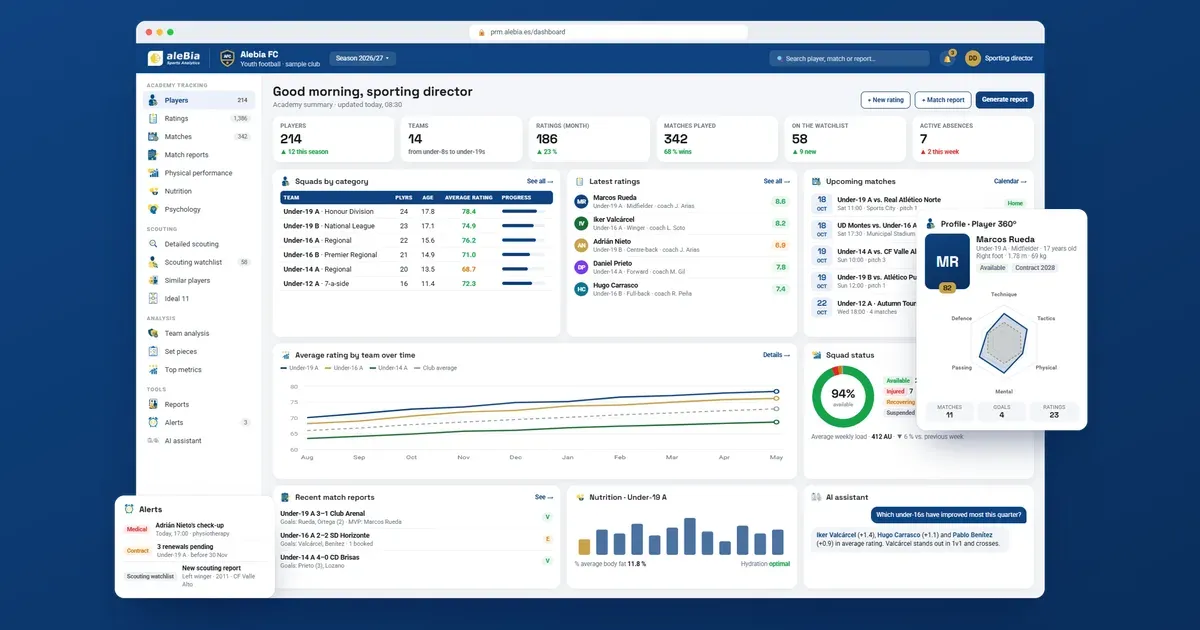
How many different places does your club keep a player’s information? At many clubs, the contract is in one file, the statistics in a provider’s tool, the scouting reports in loose documents, the injuries in the medical department and plenty of important things in many people’s heads. All of it is valuable information, but none of it is connected. That is the problem a CRM solves, an idea that businesses have applied for decades and that football is only just starting to consider.
What a CRM is in the business world
CRM stands for Customer Relationship Management. It is the system a company uses to centralise everything it knows about each customer: their data, history, contacts, incidents and opportunities. Sales, marketing and customer service stop working each on their own and work from the same information.
It is common in sectors such as telecommunications, energy, banking or insurance, where nobody would consider managing thousands of customers without a shared system. It is not adopted on a whim, but because it provides four very concrete things:
- A single version of the truth. Everyone consults the same data, and contradictions between departments disappear.
- Organisational memory. Knowledge no longer depends on individuals: if someone leaves, what they knew stays.
- Traceability. You know what was decided, by whom, when and with what information. The parts of a process are connected.
- The ability to act in time. With everything in one place, it is possible to follow the customer lifecycle, spot when an important milestone is approaching, see when something needs changing and recognise when an event requires a decision.
What changes in football: the asset is the player
A football club also manages relationships, but its main asset is not a customer: it is the player (the season-ticket holder requires a separate discussion). The player is a sporting, economic and human asset at once, and many areas work around them: the sporting department, the technical secretariat, scouting, the academy, the coaches, the medical staff, the analysts and the contractual side. All of them need to be connected.
Allowing for differences, this ecosystem can be described as the football CRM, and at Alebia we call it the PRM, Player Relationship Manager. We are pioneers in this industry and in this specific idea, but we have not invented anything: we have adapted to football what has been working for years in other sectors, placing the player at the centre of the profile, the data and the decision.
It is worth clarifying. In football there are two major relationships to manage: the club’s relationship with the player and its relationship with the season-ticket holder. A CRM aimed at the season-ticket holder, the club’s special customer, would make a lot of sense and has enormous potential, and at Alebia we also have it in mind. But Alebia’s vocation focuses on the player: the one who is yet to arrive and also the one already inside the club. Without leaving the season-ticket holder or the member aside, as we will see below.
More than a scouting tool
Scouting is an important piece, but sporting management needs to work on many more questions: what we have, how each player is developing, what contract they have, what their performance and health status is, what we will need next season and what risks there are.
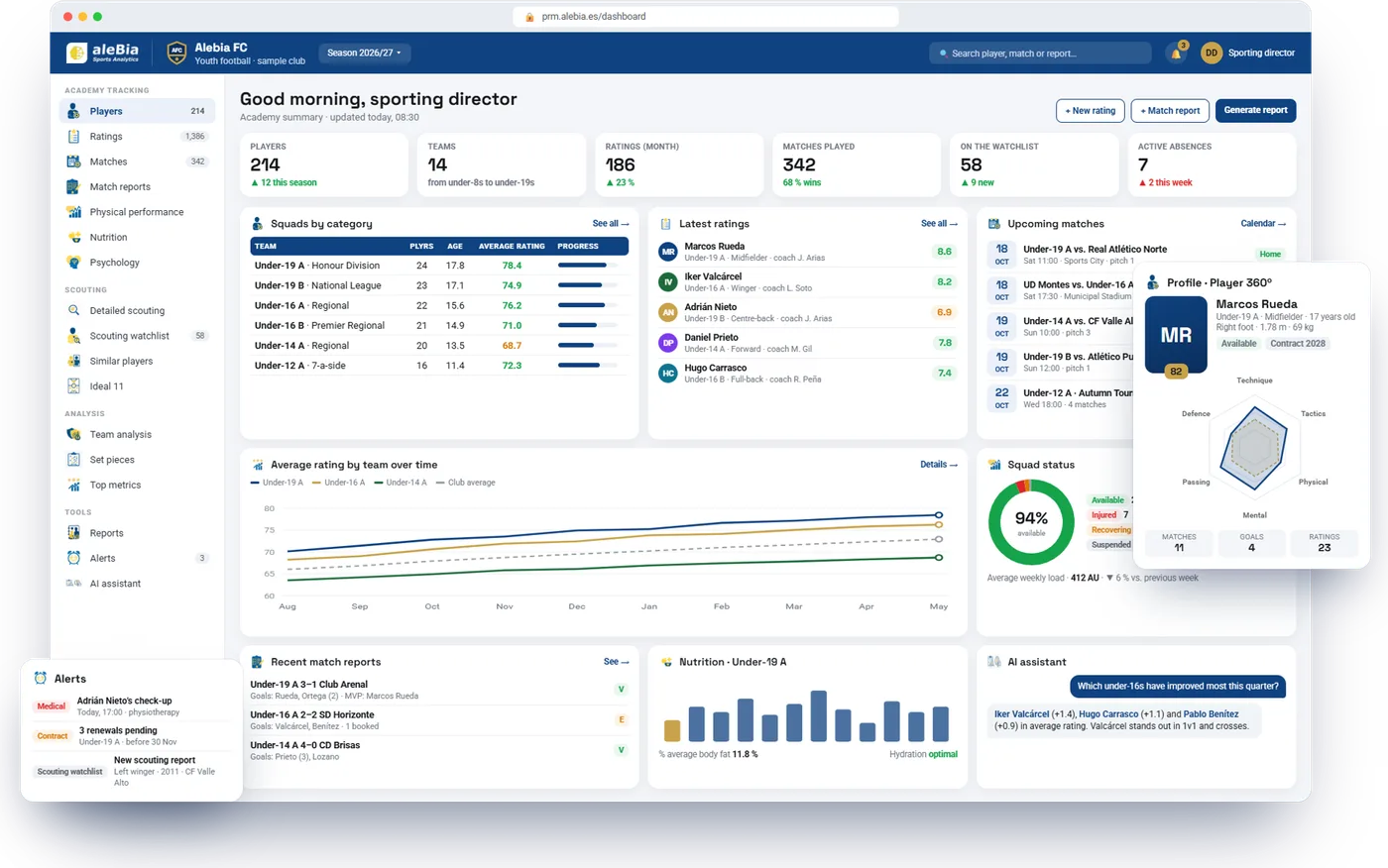
That is why Alebia is more than a set of scouting tools. It is an integrated system that connects all the areas of the club with the player at the centre. What the academy records can be consulted by the technical secretariat; what is discovered in a scouting visit feeds the player profile; and reports, ratings and performance data live in the same place, with different permissions for each user.
A vision that comes from the business world
Alebia was not born from football alone. The founding partners have spent years applying big data, data science, data governance and business intelligence across a wide range of sectors, where data-driven technologies are already a must. That is why the PRM was not designed as just another football programme, but on the basis of what already works in a company, adapted to the dynamics of a club.
From CRM to integrated platform
The PRM does not have to stay on the pitch. Alebia can also build modules for what happens off the field: marketing, finance, advertising and interaction with the season-ticket holder, including their loyalty and churn rate. There the CRM becomes a broader platform for management, information and operations. The system makes even more sense, because it brings the sporting and business areas into the same ecosystem. You can see examples in Beyond the pitch.
Independent modules, connected to each other
The key to this approach is that it is not a closed product. The PRM is made up of independent modules that are connected to each other and share the same data model. A club can start with the module it needs most, for example scouting or the player profile, and add the others when needed: ratings, match reports, physical performance, scouting follow-up, document library, training or reports.
There is no need to buy everything or start from scratch. Each sports organisation builds its platform with the pieces it wants, configures them its own way and grows its data ecosystem according to its needs, its capabilities and its goals. And since we are agnostic about data providers, the system integrates both the club’s own data and that of any external provider.
How to start
The best way to approach a football CRM is not to start with the technology, but with three simple questions: where your players’ information is today, who needs it and which decision would improve if it were all together.
The answer usually shows which module to start with, and the rest is added as the club needs it, without redoing what already works.
If you want to see how it works, you can get to know Alebia’s PRM, its advanced scouting pieces or the BI platform and data governance that goes with it. And if you would rather tell us about your case, let’s talk.